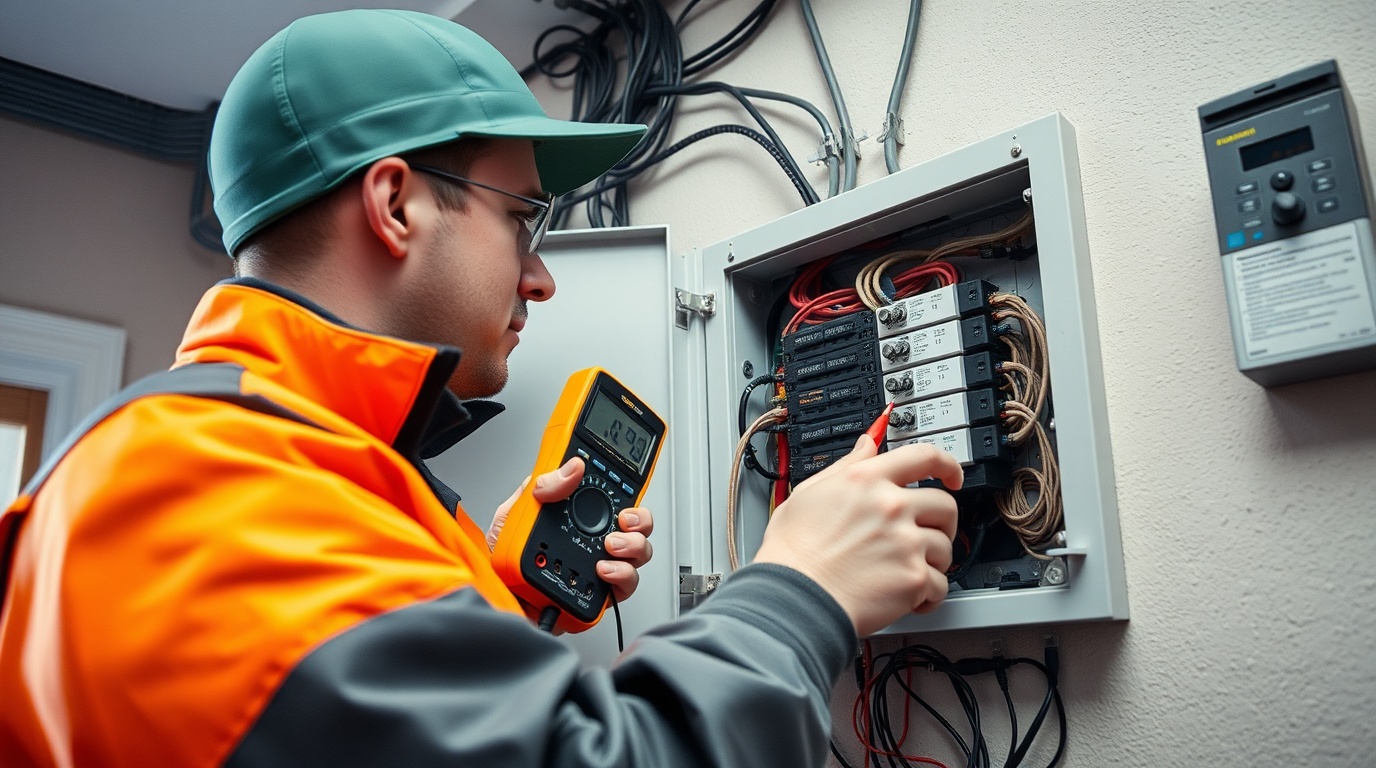
The short answer
A commercial EICR generally costs more than a domestic one because commercial premises usually have more circuits, larger installations, and often a three-phase supply rather than the single-phase supply found in most homes. A domestic EICR is typically £100–£300; a commercial EICR is harder to generalise but commonly starts from a few hundred pounds for a small shop or office and rises with the size and complexity of the premises, into four figures for larger or industrial sites. Most commercial inspections are quoted on a per-circuit basis after a site assessment, because no two commercial installations are alike. These are typical ranges for guidance, not quotations.
Commercial and domestic EICRs check the same kind of thing — the fixed wiring — but commercial premises are usually larger and more complex, which is why they cost more. Here is what drives the difference and how the figure is reached.
Commercial vs domestic EICR
- Domestic EICR~£100–£300
- Small shop / officefrom a few hundred pounds
- Larger / industrialfour figures+
- Supplyoften three-phase
- Usually quotedper circuit, after a site visit
Why commercial costs more
The reasons a commercial EICR usually carries a higher price than a domestic one all come back to the size and complexity of the installation being tested:
- More circuits: commercial premises typically have far more circuits than a home — multiple lighting zones, general power, dedicated supplies for equipment and machinery — and each circuit is tested individually, so the circuit count is the single biggest driver of the figure.
- Three-phase supply: many commercial sites use a three-phase supply rather than the single-phase common in homes, which adds both complexity and testing time, and requires the electrician to assess the balance and condition across all three phases.
- Size and access: larger floor areas, distribution boards tucked away in plant rooms or risers, and live business operations to work around all add time to the visit.
- Specialist installations: commercial kitchens, workshops, server rooms, refrigeration and the like require more careful assessment than the straightforward circuits of a home.
These factors compound, just as they do domestically. A small lock-up shop with a single board and a handful of circuits is not far removed from a domestic job, while a multi-floor office, a busy restaurant kitchen, or a workshop full of machinery sits at a wholly different scale — which is exactly why a single headline figure for 'a commercial EICR' is impossible to give.
| Premises | Typical EICR cost | Notes |
|---|---|---|
| Domestic home | ~£100–£300 | single-phase, fewer circuits |
| Small shop / office | from a few hundred pounds | more circuits |
| Larger commercial unit | four figures+ | often three-phase |
| Industrial site | quoted individually | highly variable |
Indicative UK figures for guidance — commercial work is usually quoted per circuit after a site visit. Sources: trade cost guides.
How commercial EICRs are usually priced
Because commercial installations vary so much, most electricians quote a commercial EICR after assessing the site or on a clear per-circuit basis rather than a flat fee. To give an accurate figure they need to know the number of distribution boards, the total circuit count, whether the supply is single- or three-phase, and how the premises are actually used day to day. A walk-round or a request for the existing electrical drawings is common before a firm quote, precisely because guessing at a commercial site's circuit count is far less reliable than it is for a standard home.
The per-circuit approach means you pay in proportion to the size of the installation, which is the fairest basis when premises differ so widely. It also makes comparing quotes more straightforward: two electricians pricing the same site on a per-circuit basis, against the same circuit count, should produce comparable figures, whereas two flat-fee quotes for 'a commercial EICR' could be assuming completely different premises. As with domestic work, the figure should cover the full installation, every circuit, the inspection and the written report, and you should check whether VAT and any certificate fee are included before comparing one quote with another.
A site assessment also lets the electrician plan around how the premises actually run, which matters more commercially than it does at home. An inspection involves isolating circuits, and in a working business that can mean coordinating around trading hours, refrigeration that cannot be switched off, tills and card systems, or machinery on a production line. Some commercial EICRs are therefore quoted to include out-of-hours or phased working so the business is not interrupted, which is a genuine cost the per-circuit figure has to absorb. This is another reason a flat 'commercial EICR price' is meaningless without context: the same circuit count can take materially longer, and cost more, on a site that cannot simply have its power turned off for the morning.
What is the same as domestic
Despite the cost difference, a commercial EICR checks the same fundamentals as a domestic one. It is carried out to BS 7671, the 18th Edition Wiring Regulations, and records faults against the same C1 (danger present), C2 (potentially dangerous) and C3 (improvement recommended) codes, with the same overall satisfactory or unsatisfactory outcome. The electrician carries out the same kind of visual inspection and dead and live testing — earthing and bonding, insulation resistance, polarity, and the correct operation of protective devices — just across a larger and often more complex installation. The remedial work to put right any faults is, as with domestic, quoted separately once the report is known.
Where commercial differs is in how often the inspection is expected. The general domestic guidance of at least every ten years for an owner-occupier, or the five-year legal cycle for a let home, does not map directly onto commercial premises. Many commercial installations are inspected on a shorter cycle — often every few years — depending on the type of environment, how heavily the installation is used, and what an insurer or a duty-holder's risk assessment requires. The principle is identical to domestic work: an impartial inspection of the fixed wiring to a recognised standard, with the result recorded and any remedial work priced separately. What changes is the scale of the installation and the frequency expected of it, not the nature of the check itself.
Who is responsible, and why it matters
In a commercial setting the duty around electrical safety usually sits with the person in control of the premises — an employer, a business owner, or a landlord of commercial space — rather than with an individual occupier as in a home. Workplace electrical safety is underpinned by duties to maintain electrical systems in a safe condition, and a periodic EICR is the standard way to demonstrate that the fixed installation has been assessed and is in good order. That is part of why commercial inspections are often on a tighter cycle and why insurers and risk assessments frequently drive the timing.
For anyone arranging a commercial EICR, the practical points are to establish clearly who holds the duty, to keep the report and any remedial certificates on file as evidence of compliance, and to budget for the inspection as a recurring business cost scaled to the size of the premises. As with domestic work, the inspection fee is payable whatever the result, and an unsatisfactory report adds the separate cost of remedial work to bring the installation back to a satisfactory condition. Treating the commercial EICR as a planned, proportionate cost — quoted per circuit against the real installation — keeps it predictable and ensures the premises stay both safe and demonstrably compliant.
For a business juggling several sites, the most practical approach is to treat the EICR like any other scheduled compliance cost — alongside fire safety, gas where relevant, and insurance renewals — and to keep the inspection cycle on a calendar rather than reacting when a certificate lapses. Knowing the circuit count and supply type for each property in advance makes re-quoting straightforward at each interval, and a relationship with an electrician who already holds the site's drawings tends to make subsequent inspections quicker and easier to price. The headline point for anyone comparing commercial with domestic is simply this: the inspection is the same kind of check to the same standard, but the scale, the frequency and the way it has to be worked around a live business are what move the figure, and a per-circuit quote against the real installation is the only reliable way to capture that.
Frequently asked questions
Why does a commercial EICR cost more than a domestic one?
Commercial premises usually have more circuits, larger installations and often a three-phase supply rather than the single-phase found in homes. Since an EICR is priced on the circuits tested, more circuits and added complexity mean a higher cost.
How is a commercial EICR priced?
Most commercial EICRs are quoted per circuit or after a site assessment, rather than as a flat fee, because installations vary so much. The electrician needs the circuit count, the number of distribution boards and whether the supply is three-phase to give an accurate figure.
Is a commercial EICR the same standard as a domestic one?
Yes. Both are carried out to BS 7671, the 18th Edition Wiring Regulations, and use the same C1, C2 and C3 codes and satisfactory or unsatisfactory outcome. Commercial premises are often inspected more frequently depending on use and insurer requirements.
Sources & further reading
Figures on this page are typical UK ranges drawn from published sources and depend on your specific property. They are guidance, not a quotation. Legal duties are summarised for guidance — confirm the current position on GOV.UK.